
If you run Facebook or Instagram ads, boost posts, or pay influencers, the latest ASCI complaints report is worth five minutes. The Advertising Standards Council of India (ASCI), the self-regulatory body of the Indian advertising industry, released its Half-Yearly Complaints Report for April–September 2026 this week, and its headline is blunt: 98% of the violations it identified originated on digital media.
The report was covered on 25 November 2026 by The Hindu BusinessLine and exchange4media. Below, every number is taken from ASCI’s own report, followed by what we think it means for a local business.
ASCI complaints report: the key numbers
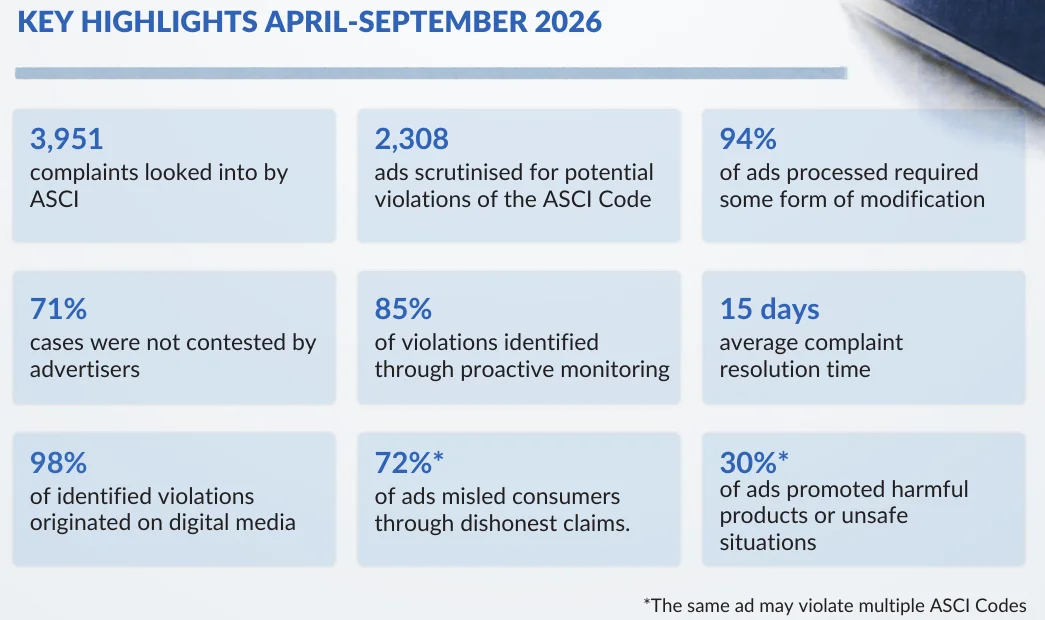
Between April and September 2026, ASCI says it:
- looked into 3,951 complaints and scrutinised 2,308 ads for possible violations of the ASCI Code;
- found that 94% of the ads it processed needed some form of modification;
- found that 72% misled consumers through dishonest claims and 30% promoted harmful products or unsafe situations (one ad can break more than one rule);
- identified 85% of violations through its own proactive monitoring, not complaints;
- saw 71% of cases go uncontested, with an average resolution time of 15 days (down from 17 days in FY 2025–26).
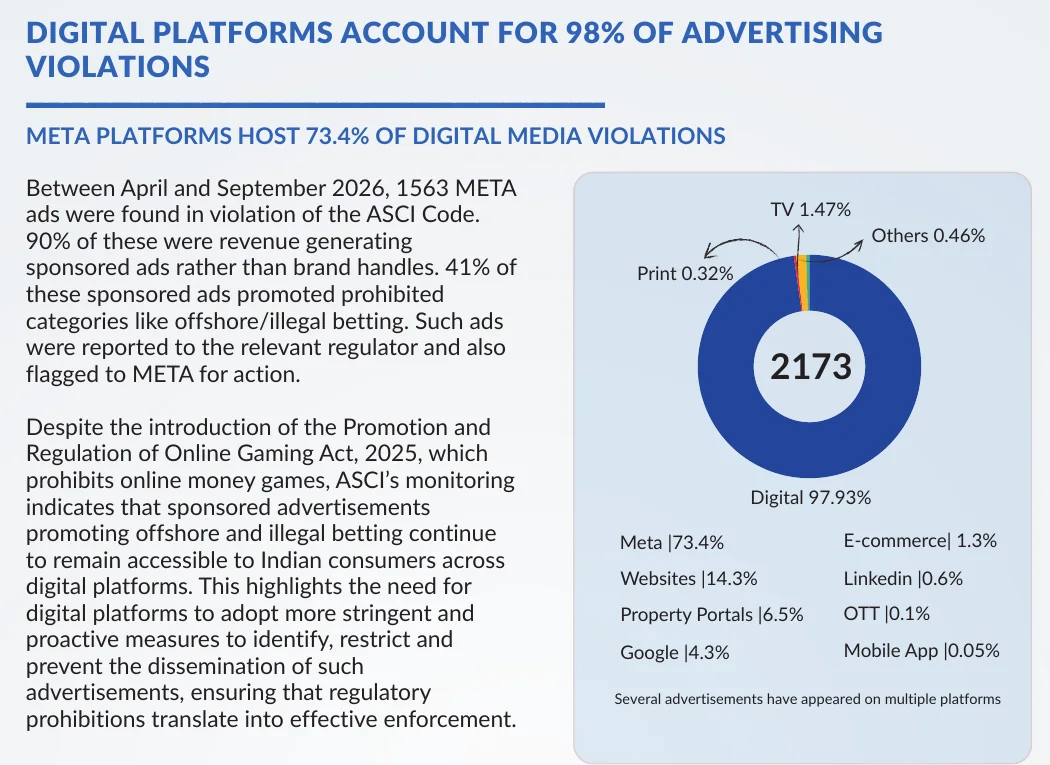
Digital media: 98% of violations, Meta 73.4%
Of the 2,173 ads ASCI found in violation, 97.93% were on digital media; TV, print and others made up the rest. Within digital, ASCI’s chart shows Meta at 73.4%, websites 14.3%, property portals 6.5%, Google 4.3%, e-commerce 1.3% and LinkedIn 0.6% (some ads appeared on more than one platform).
The detail that matters most for small advertisers: ASCI says 1,563 Meta ads broke the Code, and 90% of these were revenue-generating sponsored ads rather than posts from brand handles. In other words, the problem was mostly paid ads, not organic posts. ASCI also says 41% of those sponsored ads were for prohibited categories such as offshore or illegal betting, which it reported to regulators and flagged to Meta.
Which categories broke the rules most
ASCI says seven categories drove 90% of the violations: offshore/illegal betting (590), personal care (456), real estate (360), food and beverage (312), electronics and consumer durables (95), healthcare (82) and education (68). A few points from the report that local businesses should note:
- Personal care: the most influencer violations, with unproven skin and hair “transformation” claims and exaggerated before-and-after visuals.
- Food and beverage: 74% of these ads were for nutraceuticals, often with health claims that lacked scientific backing.
- Real estate: under an agreement with the Telangana Real Estate Regulatory Authority, ASCI referred 333 ads to TGRERA for missing mandatory details such as project registration numbers, website details and approvals. That is directly relevant to builders and brokers advertising in Hyderabad.
- Healthcare: 82 violations; ASCI also referred 4 hospital or clinic ads to the medical regulator (named in the report as the National Medical Council) for guideline violations.
Influencer ads: 95% needed changes
ASCI processed 659 ads for influencer-related violations, and 95% required modification. On the positive side, 83.5% of influencers corrected their posts without contesting, within an average of six business days, and ASCI puts overall influencer compliance at 95% as of 17 November 2026 (88% the year before).
If you pay creators, make sure every paid post is clearly labelled. For health and nutrition content, ASCI’s CEO reminded advertisers in an interview with ETHealthworld (20 November 2026) that its influencer guidelines expect relevant qualifications, such as a medical degree or a certified nutritionist, for that kind of advice. Our influencer marketing work follows the same disclosure rules.
Coming next: labels for AI-made ad content
One more change is close. On 29 September 2026 ASCI released guidelines on labelling synthetically generated (AI) content in advertising, which take effect three months from publication. In short:
- Always banned, label or not: fabricated endorsements or testimonials, exaggerated results through synthetic visuals, fake locations presented as real, and deepfakes or anyone’s likeness without consent.
- Label required: synthetic influencers, replicated voices or likenesses, fabricated settings that affect understanding of the product, demos of products that don’t exist yet, and paid AI product suggestions (“Sponsored by [Brand]”).
- No label needed: routine edits such as colour correction, decorative elements, obvious fantasy effects, AI-written ad copy and accessibility uses such as subtitles.
If you are using AI tools for creatives, read our AI consultancy page or our recent post on Google AI Mode.
6 checks before you run or boost an ad
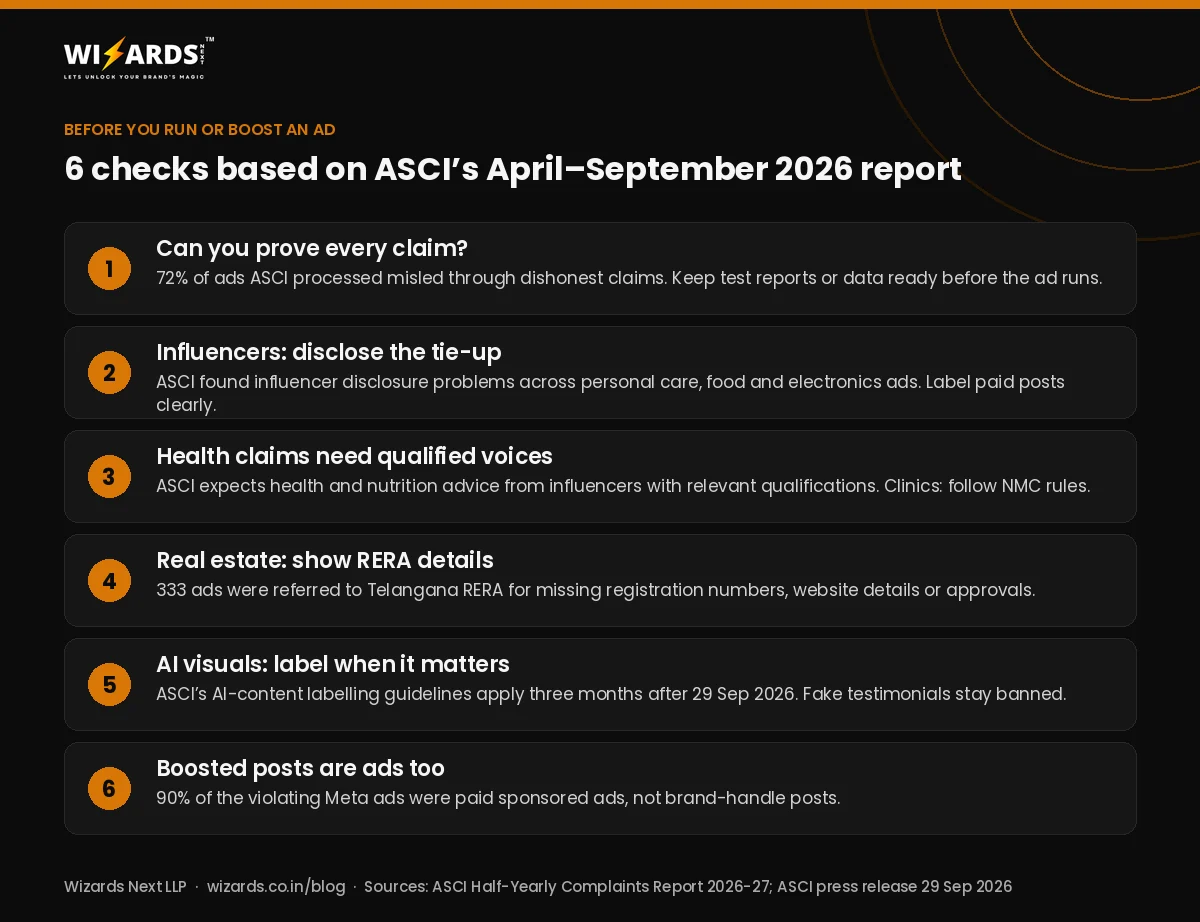
- Keep proof for every claim. “Best”, “No. 1”, “guaranteed results” or before-and-after pictures need evidence you can show if asked.
- Label paid creator posts. If you gave money, free products or any other benefit, the post must say so clearly.
- Use qualified people for health advice. Clinics and doctors should also follow National Medical Commission rules; our healthcare marketing page explains how we approach this.
- Real estate: put the RERA number and website on the ad. The TGRERA referrals show this is being checked.
- Label AI content when it could change what a customer believes. Never use AI to create a testimonial or a “customer” who doesn’t exist.
- Treat a boosted post like an ad. ASCI’s Meta numbers were mostly paid sponsored ads, so check boosted posts as carefully as campaign ads.
Anyone can file a complaint with ASCI free of charge through its website, and ASCI says the number of complaints from the public has been rising since FY 2024–25. A complaint that leads to a withdrawn ad wastes the money you spent on it, so these checks are cheap insurance.
What this means for businesses in Varanasi and beyond
Most of the businesses we work with advertise on Instagram and Facebook, which is exactly where ASCI found most problems. The fix is not to stop advertising; it is to make claims you can back up and be open about paid partnerships. That also tends to build more trust with customers.
If you want help planning compliant social media marketing or Google and Meta ads, see our digital marketing agency in Varanasi page or book a free call. We also wrote about how India’s DPDP consent managers affect marketing data.
Frequently asked questions
What is the ASCI complaints report?
It is a report by the Advertising Standards Council of India on the complaints it handled and the ads it found in violation of the ASCI Code. The half-yearly report released in November 2026 covers April to September 2026.
What share of ad violations were on digital media?
ASCI says 98% of the violations it identified between April and September 2026 originated on digital media. Of the digital violations, Meta platforms accounted for 73.4%.
Are boosted Instagram and Facebook posts covered?
Yes. ASCI reviews advertisements across all media. Of the 1,563 Meta ads it found in violation, 90% were revenue-generating sponsored ads rather than posts from brand handles.
Do AI-generated ads need a label in India?
Under ASCI’s guidelines released on 29 September 2026, which take effect three months after publication, a label is required when synthetic content materially influences consumer decisions, for example synthetic influencers or replicated voices. Routine edits and AI-written copy do not need a label, and fake testimonials are not allowed even with a label.
Sources
- ASCI: Half-Yearly Complaints Report, April–September 2026 (PDF)
- ASCI: Press announcements
- The Hindu BusinessLine: Digital media accounts for 98% of advertising violations, Meta leads with 73.4% (25 Nov 2026)
- exchange4media: Digital platforms account for 98% of ad violations, Meta leads with 73.4% (25 Nov 2026)
- ASCI press release: Guidelines for Responsible Labelling of Synthetically Generated Content in Advertising (29 Sep 2026, PDF)
- ETHealthworld: Substantiation cannot be an afterthought in nutraceutical advertising, ASCI CEO (20 Nov 2026)
Written by Ravi Khetan, Founder, Wizards Next LLP, a digital marketing agency in Varanasi. About us