
If your business collects enquiries through a website form, a WhatsApp number or a Meta lead ad, India’s data protection law now has a date you should know. On 13 November 2026 the registration framework for Consent Managers under the Digital Personal Data Protection (DPDP) Act, 2023 came into effect, and MeitY Secretary S. Krishnan launched the portal dpbi.gov.in for companies that want to register, according to the Press Information Bureau release of 14 November 2026.
This post explains what a Consent Manager is, why most businesses don’t need to become one, and what the DPDP Act for businesses really asks of your marketing from 13 May 2027. It is based on the Act, the DPDP Rules, 2025, the PIB release and reporting by The Hindu BusinessLine and MediaNama. It is a plain-language summary, not legal advice.
What happened on 13 November 2026
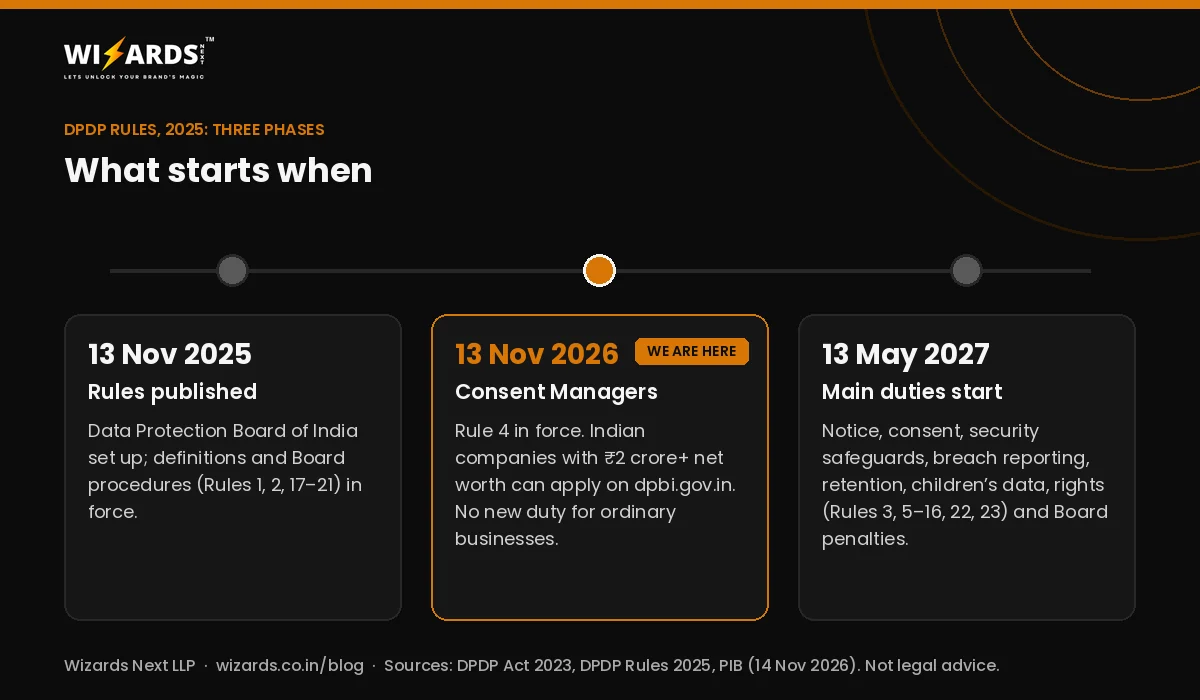
The DPDP Rules, 2025 were published in the Gazette on 13 November 2025 and come into force in three steps. Rule 1 says Rule 4, on the registration and obligations of Consent Managers, “shall come into force one year after the date of publication”. That year ended on 13 November 2026.
According to PIB, companies incorporated in India “with adequate technical, operational and financial capacity, including a net worth of not less than ₹2 crore” can now apply to the Data Protection Board of India through the portal. The Board will assess applications and publish the list of registered Consent Managers on its website.
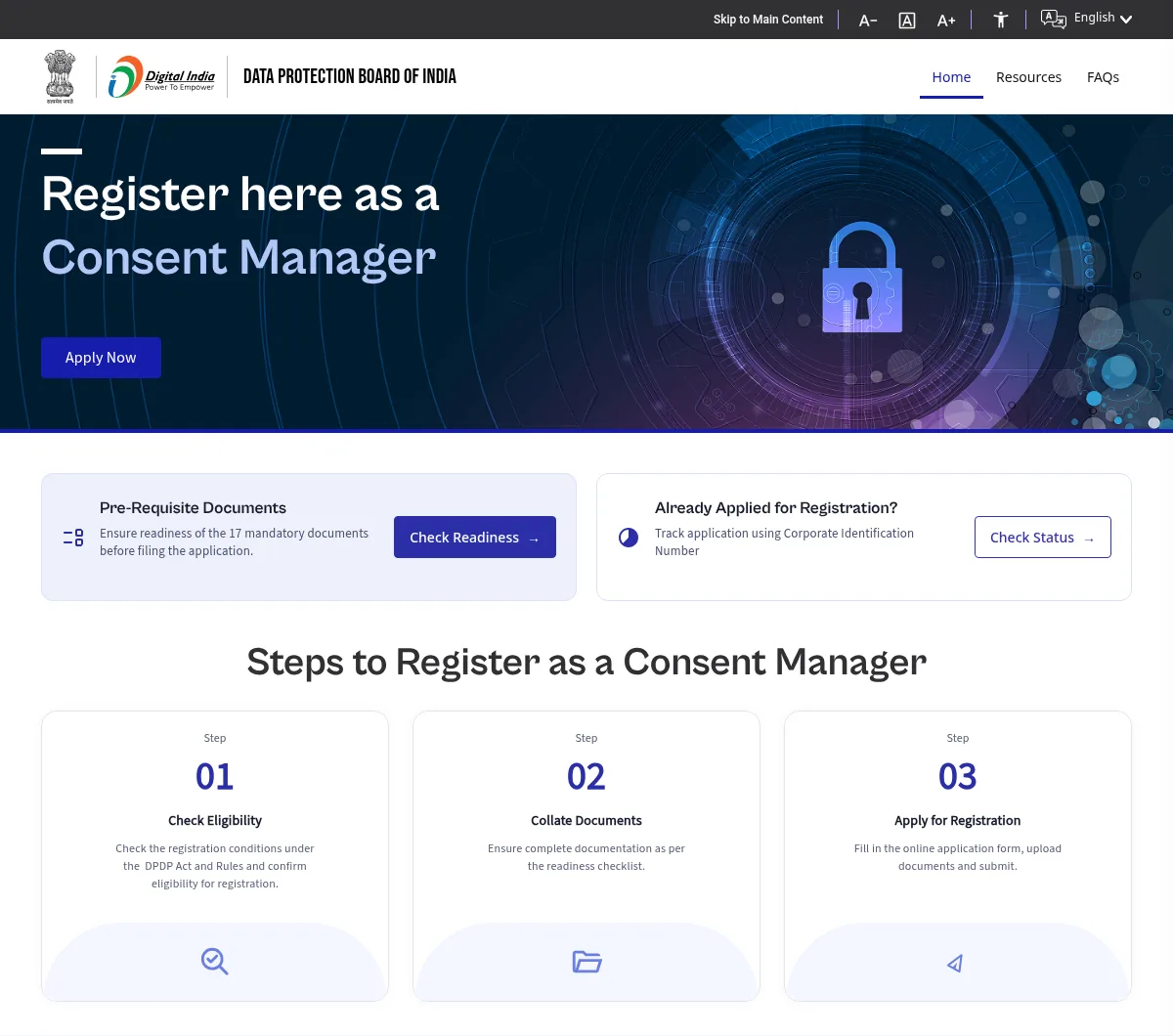
One caveat from MediaNama (16 November 2026): the Board that has to approve these applications “isn’t functional yet”. MediaNama could not find a public notification appointing its chairperson or members, so it is not clear when the first Consent Managers will actually be registered.
What is a Consent Manager?
The Act defines a Consent Manager as a single point of contact that lets a person give, manage, review and withdraw consent through “an accessible, transparent and interoperable platform”. Think of it as a dashboard where a customer could see which businesses they have allowed to use their data, and switch that permission off.
Section 6(7) of the Act says a person “may” use a Consent Manager. It is an option for your customers, not a replacement for your own duties. If a customer withdraws consent through one, you still have to stop using their data.
Do you need to register? Almost certainly not
Registration is for companies that want to run a consent platform as a service. The Rules set a high bar: an Indian company with at least ₹2 crore net worth, independently certified technology, no conflict of interest with the businesses on the platform, and consent records kept for at least seven years. A clinic, coaching institute, retailer or local service business collecting leads does not need to apply.
So 13 November 2026 brings no new duty for an ordinary business. The date that matters for your marketing is the next one.
What starts on 13 May 2027
PIB confirms that the provisions on the rights of Data Principals (your customers), the obligations of Data Fiduciaries (businesses that decide how personal data is used) and the Board’s inquiry and penalty processes are scheduled to come into effect on 13 May 2027. For marketing teams, four rules in the Act and Rules matter most:
- Valid consent. Section 6(1): consent must be “free, specific, informed, unconditional and unambiguous with a clear affirmative action”, and limited to the data needed for the stated purpose. The Act’s own example: a telemedicine app cannot bundle access to your phone contacts into consent for the medical service.
- A clear notice. Rule 3: the notice must stand on its own, in clear and plain language, with an itemised description of the personal data, the specific purpose, and how the person can withdraw consent, exercise their rights and complain to the Board. Section 6(3) adds that people must be able to read the request in English or any language in the Eighth Schedule of the Constitution.
- Easy withdrawal. Section 6(4): withdrawing consent must be as easy as giving it. Section 6(6): after withdrawal you must stop processing within a reasonable time, and make your Data Processors (CRM, email or WhatsApp vendors) stop too.
- Security and breaches. The Act’s Schedule allows penalties of up to ₹250 crore for failing to take reasonable security safeguards, and up to ₹50 crore for breaches of other provisions.
What this means for leads, WhatsApp lists and ad audiences
Most small businesses collect personal data in more places than they realise: the contact form, the WhatsApp Business number, Meta and Google lead forms, the walk-in register, event sign-ups and lists shared by a partner or bought from a vendor. Each of these will need a clear purpose, a notice and a way to opt out.
Two practical examples. If you add every enquiry to a WhatsApp broadcast list, people should know that when they give their number, and should be able to stop messages as easily as they started them. If you upload customer phone numbers to Meta or Google for a custom audience, you should be able to show those customers agreed to that use. For the WhatsApp side, also see our post on WhatsApp Business changes in November 2026. For ad measurement, see the new Meta Pixel setting for conversions on customer devices.
Six checks to start before May 2027
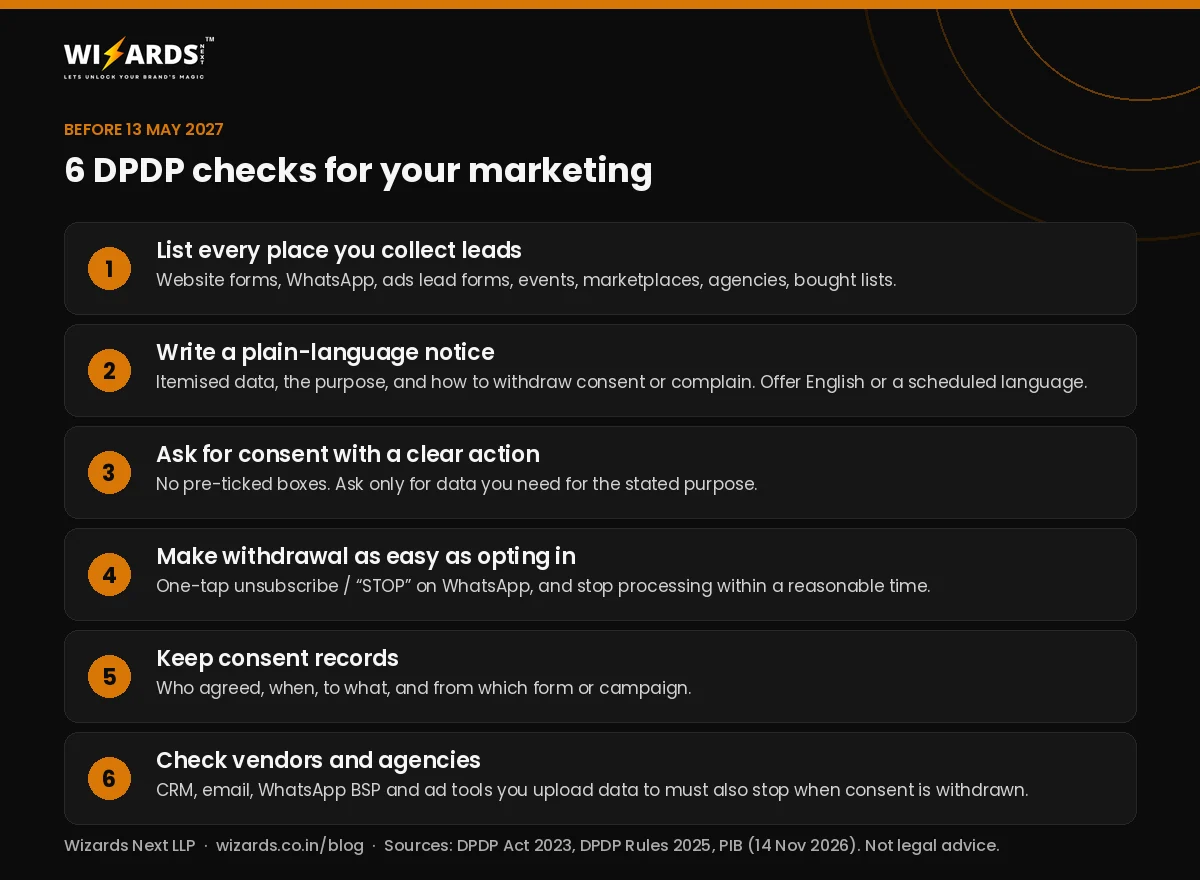
- List every place you collect personal data: website and landing-page forms, WhatsApp, ad lead forms, events, marketplaces, agencies and any bought or shared lists.
- Write a short, plain-language notice for each form: what you collect (itemised), why, and how to withdraw consent or complain. Offer it in the languages your customers use.
- Ask for consent with a clear action: no pre-ticked boxes, and separate tick boxes for separate purposes (for example, “reply to my enquiry” vs “send me offers on WhatsApp”).
- Make opting out one step: an unsubscribe link in emails, a simple “STOP” reply on WhatsApp, and a process to remove people from lists and ad audiences.
- Keep consent records: who agreed, when, to what, and through which form or campaign.
- Check your vendors and agency contracts: CRM, email, WhatsApp provider and ad tools should be able to delete or stop using data when a customer withdraws.
None of this needs a big budget. For most small businesses it is a website form update, a few lines of notice text and a tidy CRM. Your lawyer or CA should confirm the details for your business.
How Wizards can help
Our website development team can add clear notices and separate consent tick boxes to your enquiry and booking forms, and our WhatsApp marketing and email marketing teams set up opt-in and opt-out flows that are easy for customers to use. Analytics and reporting can record where each lead came from. If you are in Varanasi, see our digital marketing agency in Varanasi and website development company in Varanasi pages, or book a free call to review your lead forms before May 2027.
Frequently asked questions
What changed under the DPDP Act on 13 November 2026?
Rule 4 of the DPDP Rules, 2025 came into force, so eligible Indian companies can apply to the Data Protection Board of India to register as Consent Managers through dpbi.gov.in. PIB announced the portal on 14 November 2026.
Does my small business need to register as a Consent Manager?
No. Registration is for companies that want to run a consent platform, and requires an Indian company with at least ₹2 crore net worth and other conditions. Ordinary businesses that collect leads do not register, and customers using a Consent Manager is optional.
When do DPDP consent and notice rules apply to businesses?
According to PIB, the obligations of Data Fiduciaries, the rights of Data Principals and the Board’s inquiry and penalty processes are scheduled to start on 13 May 2027. That includes the notice rules in Rule 3 of the DPDP Rules, 2025.
What should marketers do first?
List every place you collect personal data, add a plain-language notice and a clear consent action to each form, make opting out as easy as opting in, keep consent records, and check that your CRM, WhatsApp and ad vendors can stop using data when consent is withdrawn.
Sources
- PIB: Consent Manager Registration Framework Comes into Effect; MeitY Secretary Launches Online Registration Portal (14 Nov 2026)
- Data Protection Board of India: Consent Manager registration portal
- Digital Personal Data Protection Act, 2023 (official PDF)
- Digital Personal Data Protection Rules, 2025, G.S.R. 846(E) (official PDF)
- The Hindu BusinessLine: MeitY launches registration framework for Consent Managers under DPDP Act, 2023 (14 Nov 2026)
- MediaNama: Companies can now apply to become consent managers under the DPDP Act. Who will approve them? (16 Nov 2026)
Written by Ravi Khetan, Founder, Wizards Next LLP, a digital marketing agency in Varanasi. About us