
If you check Google Search Console for your business website, there is one question it now answers for you: how many of your clicks come from people who already know your name, and how many come from people who are discovering you for the first time? Google calls this the split between branded and non-branded queries. On 16 November 2026, Google made that split, and two other report features, available in the Search Analytics API as well.
Below is what changed, what the Search Console branded queries filter actually measures, and how a local business (or the agency running its SEO) should use it. Everything here comes from Google’s own posts and documentation, plus the reports linked in the sources.
What Google announced on 16 November 2026
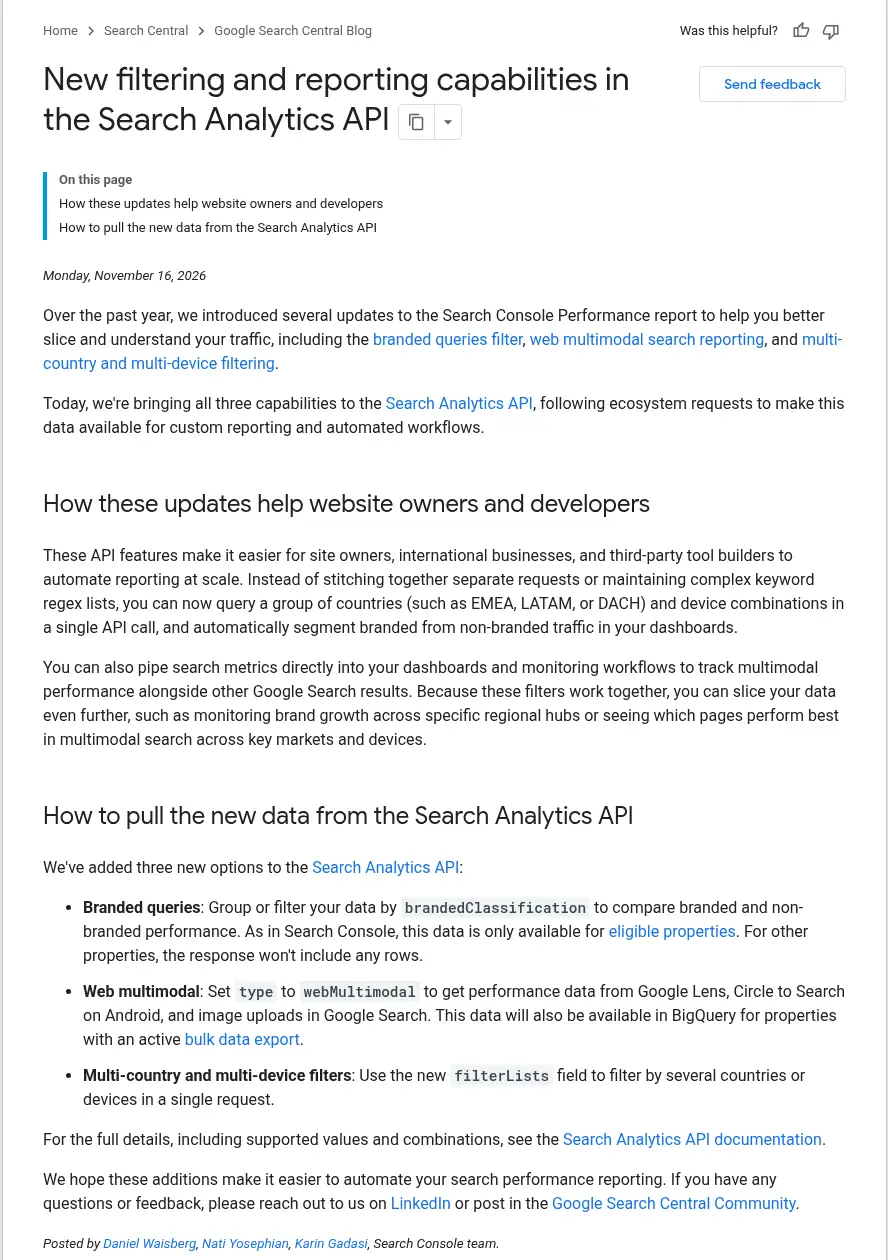
In a Search Central Blog post, the Search Console team said it is bringing three capabilities that already existed in the Performance report to the Search Analytics API, “following ecosystem requests to make this data available for custom reporting and automated workflows”:
- Branded queries: group or filter data by “brandedClassification” (values BRANDED and NON_BRANDED). As in Search Console, this is only available for eligible properties; for others the API returns no rows.
- Web multimodal: set “type” to “webMultimodal” to get performance data from Google Lens, Circle to Search on Android, and image uploads in Google Search. Google says this will also come to BigQuery bulk exports.
- Multi-country and multi-device filters: a new “filterLists” field lets you filter by several countries or devices in one request.
The Search Analytics API reference adds the fine print: branded data starts on 21 February 2026, only the “equals” operator works with it, and it can’t be combined with a query filter in the same request. Search Engine Journal also notes that the reference does not yet say how far back the multimodal data goes.
What counts as a branded query
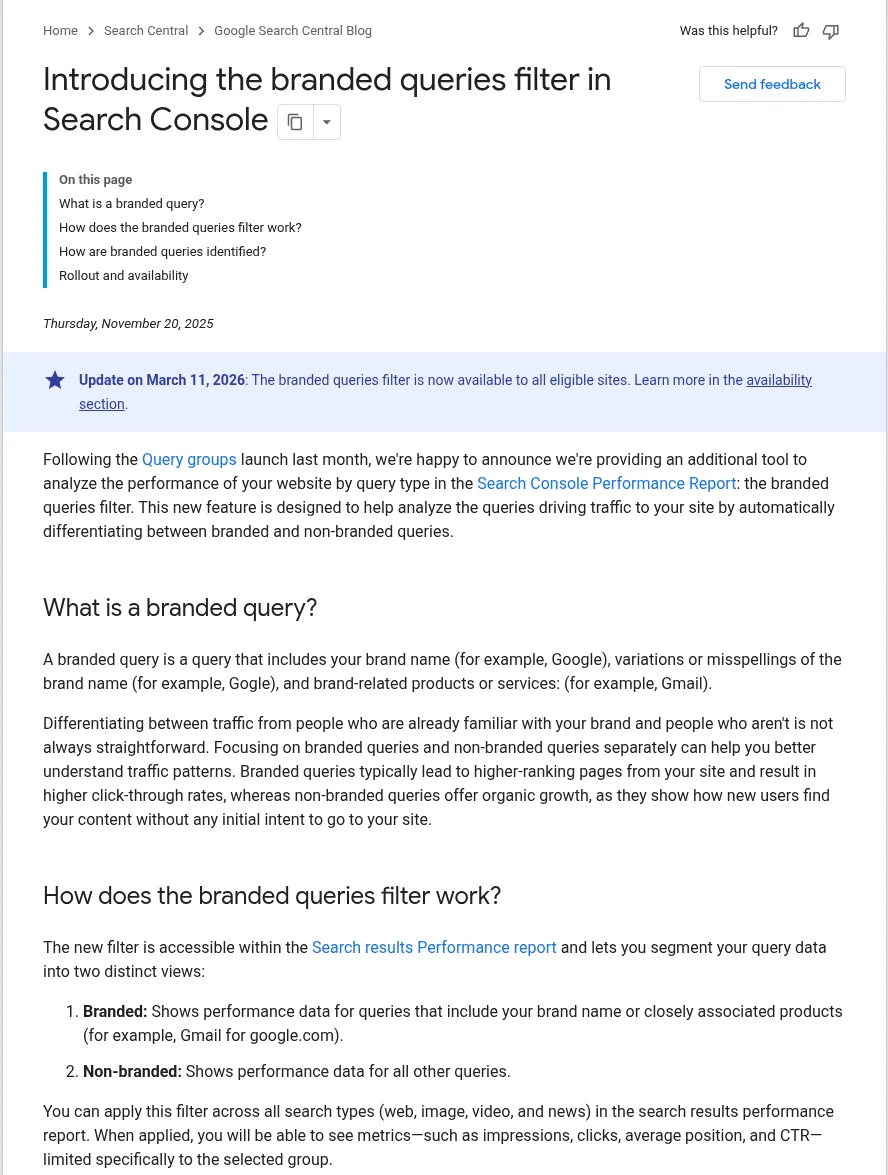
The filter itself is not new. Google introduced the branded queries filter in the Performance report on 20 November 2025 and updated the post on 11 March 2026 to say it is now available to all eligible sites. Google defines a branded query as one that includes your brand name, variations or misspellings of it, and brand-related products or services.
- It is not a keyword list. Google says the classification is done by “an internal, AI-assisted system”, not a regular expression. It covers your brand name in all languages, typos, and queries that don’t include your name but refer to a unique product or service of your site.
- It can be wrong. Google says “some queries may occasionally be misidentified.”
- It does not affect rankings. Google says the filter “has no effect on how Google Search ranking works.” It only changes how you see your data.
- Not every site gets it. It is only for top-level properties (not URL-path properties like example.com/path or subdomain properties) and only for sites with enough queries and impressions.
Branded vs non-branded: why the split matters for a local business
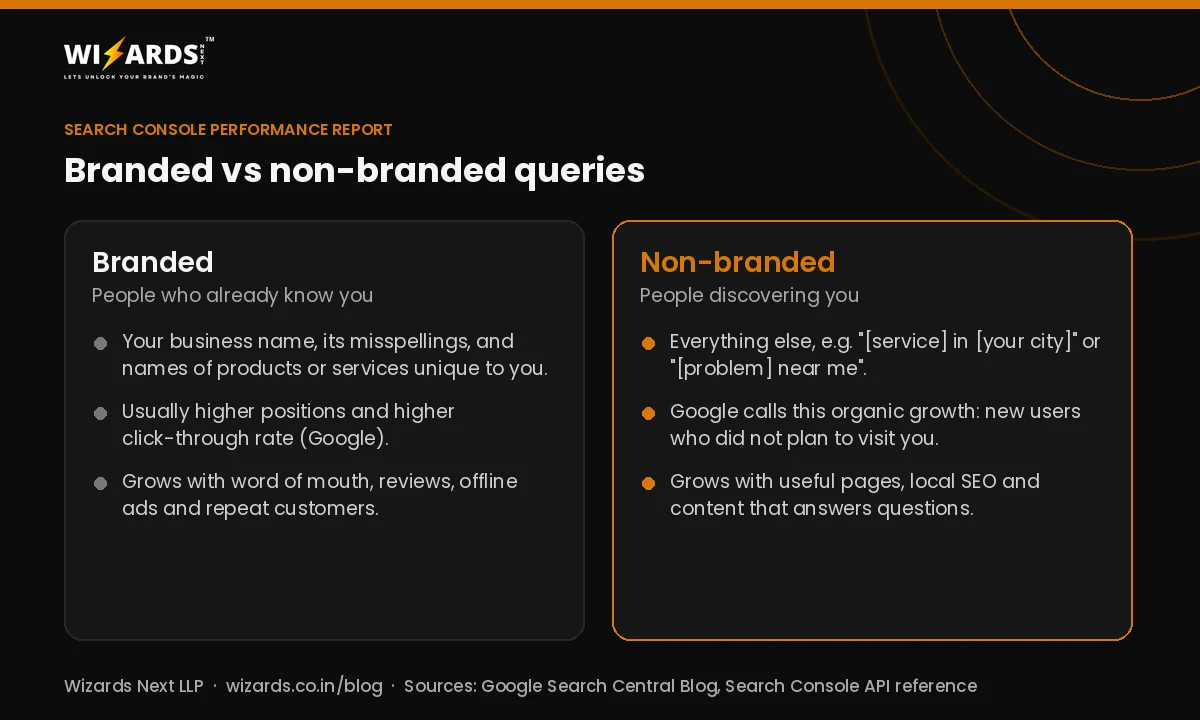
Google’s own explanation is simple: branded queries “typically lead to higher-ranking pages from your site and result in higher click-through rates, whereas non-branded queries offer organic growth, as they show how new users find your content without any initial intent to go to your site.”
For a clinic, shop, coaching centre or agency in a city like Varanasi, that difference is the whole story of SEO. People searching your business name were going to find you anyway, from a signboard, a referral, an Instagram reel or a newspaper ad. People searching for your service plus your city are the customers SEO is supposed to win. If total clicks go up only because more people search your name, your marketing is working, but your SEO may not be.
How to use it: 5 practical checks
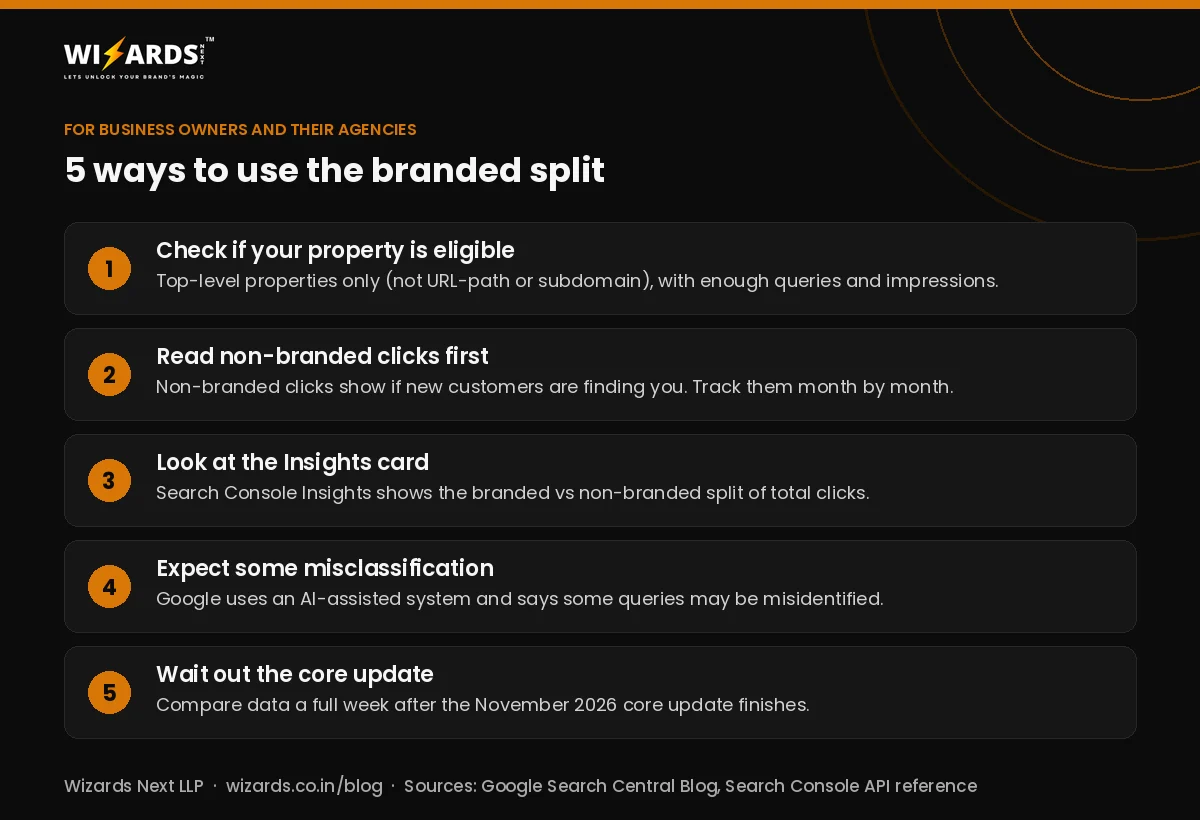
- Check if your property is eligible. In Search Console, open Performance > Search results and add a Query filter. If there is no branded/non-branded option, your property may be a URL-path or subdomain property, or may not have enough data yet. Google’s post lists both reasons.
- Read non-branded clicks first. Track non-branded clicks and impressions month by month. That is your best signal that new customers are finding you through search.
- Use the Insights card. Google added a card to the Search Console Insights report that shows the split of total clicks between branded and non-branded traffic.
- Expect some misclassification. Because Google uses an AI-assisted system, scan the queries in each group. If you used your own brand-name filter before, compare it with Google’s split rather than mixing the two in one report.
- Don’t compare across the core update too early. The November 2026 core update is still listed as active on Google’s Search Status Dashboard (checked 23 November 2026). Google’s guidance is to wait at least a full week after a core update finishes before comparing data with a period before it.
What about web multimodal data?
The second change matters for businesses with something to photograph: products, a shopfront, a dish, a design. Web multimodal data covers searches made with Google Lens, Circle to Search on Android and image uploads in Google Search. Search Console started showing this in the Performance report in September 2026, as Search Engine Journal reported, and it is now in the API too. Google says you only see this data if your site gets traffic from these searches.
If you do see it, look at which pages appear. They tell you which of your photos and products people are finding by pointing a camera at them. Google’s image SEO best practices still apply: use your own clear photos, descriptive file names and alt text, and put images near the text they relate to.
Who needs the API, and who doesn’t
Most small businesses don’t need the API at all. The same branded filter, multimodal search type and country/device filters are in the Search Console Performance report. The API matters if you or your agency build dashboards or monthly reports automatically, because those reports can now show the branded split without anyone maintaining a list of brand spellings.
At Wizards Next we read branded and non-branded performance separately for the sites we look after, because it shows whether local SEO is bringing new customers or just catching people who already know the name. If you want help setting up Search Console or reading it, see our SEO consultancy service, our SEO services in Varanasi and SEO services in Hyderabad pages, or our digital marketing agency in Varanasi. You can also book a free call.
Related reading: the November 2026 core update and Gemini 4 Hydrogen in Google AI Mode.
Frequently asked questions
What is a branded query in Google Search Console?
Google defines a branded query as one that includes your brand name, variations or misspellings of it, or brand-related products or services. Search Console classifies queries as branded or non-branded with an AI-assisted system, not a keyword list.
Why can’t I see the branded queries filter in Search Console?
Google says the filter is only available for top-level properties, not URL-path or subdomain properties, and only for sites with enough queries and impressions.
Does the branded queries filter affect my Google rankings?
No. Google says the filter has no effect on how Google Search ranking works. It only changes how your data is grouped in reports.
What changed in the Search Analytics API in November 2026?
On 16 November 2026 Google added the branded classification (BRANDED or NON_BRANDED), a webMultimodal search type for Google Lens, Circle to Search and image uploads, and filterLists for several countries or devices in one request.
Sources
- Google Search Central Blog: New filtering and reporting capabilities in the Search Analytics API (16 Nov 2026)
- Google Search Central Blog: Introducing the branded queries filter in Search Console (20 Nov 2025, updated 11 Mar 2026)
- Search Console API reference: Search Analytics query
- Search Engine Journal: Branded Query Data Is Now In The Google Search Console API (17 Nov 2026)
- Search Engine Land: Google Search Analytics API gains new filters and reporting (16 Nov 2026)
- Google Search Status Dashboard: November 2026 core update
Written by Ravi Khetan, Founder, Wizards Next LLP, a digital marketing agency in Varanasi. About us